Practice note 01: Operatory design
Dental operatory design, read from the equipment quote backward
The layout decides what the dealer quotes, what the plumber roughs in and what you finance. Settle it before anyone orders a chair.
Dental operatory design is the arrangement of the chair, delivery system, light, cabinetry and utilities in a treatment room so the dentist and assistant can work within reach without twisting. The choices you make, chiefly the delivery style and where the floor box sits, fix most of the equipment quote. The equipment can then be financed as one package, usually with the chair package as collateral.
What is the clock concept in operatory design?
Most operatory planning starts from the clock concept. Picture the patient lying in the chair with the top of the head at the center of a clock face and 12 o'clock directly behind it. For a right-handed operator, the dentist works between 7 and 12, the assistant sits between 2 and 4, instruments pass across the patient's chest in the transfer zone between 4 and 7, and the static zone between 12 and 2 holds anything that does not need to move during a procedure: the rear cabinet, a nitrous head, sometimes the delivery unit itself.
Left-handed dentists mirror the whole thing. That matters more than people expect when a practice is being built for an associate or a future buyer, because a room plumbed for a right-handed layout cannot always be flipped without opening the floor. Ambidextrous chairs and center-mounted delivery systems exist for exactly that reason, and they cost more.
Rear, side or over-the-patient delivery: which costs what?
The delivery system holds the handpieces, air-water syringe and, on most units, the controls for the chair. Where it sits is the single biggest design decision in the room, and each position has a cost pattern that shows up later in the quote and the build-out.
| Delivery | Where it sits | Works well for | Budget effect |
|---|---|---|---|
| Rear | Behind the patient's head, on a rear cabinet or mounted at 12 | Four-handed dentistry, shared hygiene and doctor rooms, a calm patient view | Usually the plainest chair package. Needs depth behind the headrest |
| Side (swing or cart) | On an arm or cart at the operator's side | Solo operators, narrow rooms, hygiene | Moderate. Carts move between rooms, which can trim the count |
| Over the patient | On an arm that swings across the chest | One operator working without a full-time assistant, both handed use | Usually the highest chair package cost; the arm adds mechanical parts to service |
None of these is right in general. A practice that runs two assistants per doctor gains a lot from rear delivery; a hygienist working alone often prefers side delivery. Pick the style for the procedures that will actually happen in the room, then let the dealer quote it.
What does the floor box hold, and why does it matter for the budget?
Every chair needs utilities delivered to its base: compressed air, water, vacuum, a drain, electrical power and usually a data line for the monitor and sensors. They arrive at a utility floor box (sometimes called a J-box) whose exact position comes from the chair manufacturer's installation template. Move the chair six inches after the slab is cut, and someone is cutting it again.
This is where operatory design meets money. The floor box rough-in, the trenching and the lines back to the mechanical room are construction. The chair, the delivery unit and the light are equipment. Equipment financing pays for the second group without difficulty. The first group is usually paid from the build-out budget, the landlord's improvement allowance or a practice loan. Some dealers bundle part of the installation into the equipment quote, and that portion can often be financed with the hardware; ask with the quote in hand.
Rough-in. The plumbing, air, vacuum and electrical work done before walls and floors are closed, ending at the floor box. It is built to the chair maker's template, so the chair model should be chosen before the rough-in is drawn.
What does a working operatory look like?
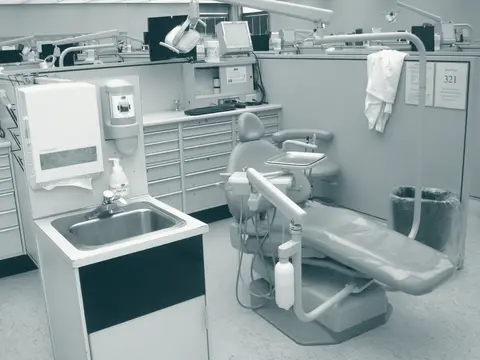
The detail in that photograph worth copying is repetition. When every room is laid out the same way, assistants find instruments by feel, one installation drawing serves every room, and a service technician carries one set of parts. It also makes the equipment easier to finance as a group, since every operatory on the quote is identical.
How do you turn a layout into an equipment budget?
Price one operatory completely, then multiply. A complete operatory is more than the chair. The list below is the way we would read a dealer's quote, and the items that most often go missing from a first draft.
- Patient chair with upholsteryUpholstery choice changes lead time more than price.
- Delivery system, with handpiece tubing for the number of handpieces you runElectric versus air-driven motors are priced separately.
- Assistant's instrumentation: HVE, saliva ejector, air-water syringe
- Operatory light, chair-mounted, ceiling or track
- Doctor and assistant stools
- Monitor arm and patient monitorOften quoted by the IT vendor, not the dealer. Include it anyway.
- Cabinetry: rear, side and the hand sinkSome cabinetry is equipment, some is millwork built in by the contractor.
- Intraoral X-ray unit and sensor, if each room gets one
- Share of the mechanical room: compressor, vacuum pump and amalgam separatorSized for the total operatory count, including rooms you plan to add later.
A general dentist plans four identical operatories with rear delivery. The dealer prices one room's chair, delivery, light, stools and cabinetry at $41,500, so four rooms come to $166,000. A compressor, vacuum pump and amalgam separator sized for six rooms add $28,000, and intraoral X-ray with sensors for each room adds $36,000. The equipment total is $230,000.
Before any finance charge, spreading $230,000 over 84 months is $230,000 ÷ 84 = $2,738.10 a month in principal alone. Over 60 months it is $3,833.33. The rate you are offered adds to both; our medical equipment financing calculator lets you enter it and see the full payment.
Which operatory design mistakes cost the most to fix?
- Ordering the chair after the slab is cut. The floor box position is model-specific. Choose the chair first.
- Sizing the mechanical room for today. A compressor and vacuum pump sized for four rooms will struggle at six. Replacing them later costs more than buying the right size once.
- Forgetting the amalgam separator. Offices that place or remove amalgam generally need one under the EPA dental effluent rule, along with a one-time compliance report.
- Mixing handedness by accident. A room set up for a left-handed associate should be designed as such, not improvised later.
- Treating the IT quote as separate. Monitors, arms and sensors are often missing from the dealer quote. If they are left out of the financing too, they end up on a credit card.
How is a set of operatories usually financed?
Most owners finance the full equipment quote, across every room, as one equipment finance agreement, with the dealer paid when installation is signed off. Terms up to 84 months suit chairs and cabinetry that can serve for many years. Faster-moving technology in the same rooms, such as sensors and scanners, can be split onto a shorter term if you prefer it paid off sooner. Our dental equipment financing page covers how the lender reviews the file, and dental office financing covers where a startup's practice loan fits alongside it.
References
- U.S. Environmental Protection Agency. Dental Effluent Guidelines, 40 CFR Part 441.
- Internal Revenue Service. Publication 946, How To Depreciate Property, for Section 179. Ask your tax advisor how it applies to you.
- Chair and delivery system installation templates are published by each manufacturer; your dealer supplies the one for the model you order.