Practice note 03: Ultrasound
Ultrasound machine financing, and why two quotes for the same model can differ by half
An ultrasound price is mostly decided by what plugs into it. Read the transducer list before the headline number.
Ultrasound machine financing pays for a cart-based, portable or handheld ultrasound system on fixed monthly payments, with the system as collateral. Provide Capital Finance finances new and refurbished units from $5,000 upward, over terms up to 84 months. How much an ultrasound machine costs depends less on the brand than on the transducers, software packages and form factor in the quote.
How much is an ultrasound machine?
There is no honest single answer, and any page that gives one is quoting a configuration you may not need. The same model can be priced very differently depending on what is bundled. Five things move an ultrasound quote more than anything else:
- Form factor. A full cart system with a large monitor and multiple transducer ports sits at the top. Laptop-style portables come next. Handheld probes that pair with a tablet or phone are at the bottom of the range.
- Transducers. Each probe is priced on its own, and specialty probes are expensive. A system quoted with one probe and the same system with four are different purchases.
- Clinical packages. Cardiac, vascular, women's health and musculoskeletal software options, plus measurement and reporting packages, are often licensed separately.
- New, demo or refurbished. Refurbished cart systems are common and can be much cheaper; ask about transducer condition above everything else.
- Service. A first-year warranty is standard on new units. Multi-year service plans are often quoted alongside and can be sizable.
So the useful way to compare quotes is line by line: the system, each transducer by name, each software option, and the service terms. Once the lines match, the headline prices start to mean something.
Which transducers do you actually need?
Buy the probes for the exams you do, plus the ones you have a concrete plan to add. The four families below cover most outpatient work.
| Practice | Usual probes | Worth knowing |
|---|---|---|
| OB/GYN | Curvilinear, endocavity; a volume (3D/4D) probe in some practices | Volume probes and their software add a good deal to the quote |
| Vascular | Linear, curvilinear for abdominal vessels | Doppler performance matters more than screen size |
| Musculoskeletal and sports | High-frequency linear, sometimes a small-footprint "hockey stick" | Portables are common because the scanner travels between rooms |
| Cardiology | Phased array; transesophageal in hospital settings | Cardiac packages and measurements are licensed separately |
| Emergency and urgent care | Curvilinear, linear, phased array | Durability and boot-up time count; portables dominate |
| Veterinary | Microconvex, linear; larger curvilinear for equine | See veterinary equipment financing |
What does a scanning room look like?
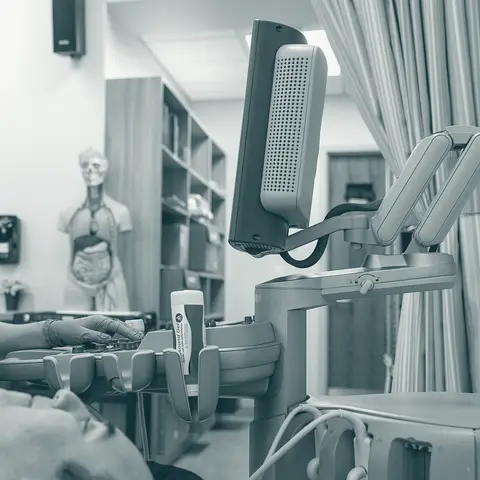
What term suits an ultrasound purchase?
Match the term to how long you expect to keep the system in front of patients. Software and image processing move faster in ultrasound than in most practice equipment, and many practices replace or upgrade a cart system on a cycle of several years. A handheld probe may be replaced sooner still.
| Form factor | Common term range | Why |
|---|---|---|
| Handheld probe | 24 to 36 months | Small ticket, fast technology cycle |
| Portable | 36 to 60 months | Moves between rooms, takes knocks |
| Cart system, new | 48 to 72 months | Larger ticket, longer working life |
| Cart system, refurbished | 24 to 60 months | Depends on age and the support horizon |
These are starting points for your own thinking, not limits. Terms up to 84 months are available, and the right term for your file comes out of the application. A fair market value lease is worth considering if you expect to upgrade at the end, because it lets you hand the system back. The rates and terms page compares the structures.
Does the scan volume support the payment?
Run the arithmetic before you sign. Take the monthly payment, add the service plan cost spread by month, and divide by the number of scans you expect each month. That gives you an equipment cost per scan to set against what each scan brings in.
A vascular practice is quoted $96,000 for a cart system with three probes and a vascular package. Before any finance charge, $96,000 over 60 months is $96,000 ÷ 60 = $1,600 a month in principal. If the practice expects 120 studies a month, that is $1,600 ÷ 120 = $13.33 of principal per study, before interest, service and the sonographer's time. Put your quoted rate into the payment calculator to replace the principal figure with a full payment.
What to have ready
- The quote, with each transducer and software option listed by name
- Whether the unit is new, demo or refurbished, and the warranty terms
- The practice's legal name, entity type and start date
- Approximate annual revenue
- For larger amounts: two years of business tax returns and a year-to-date profit and loss statement
Ultrasound financing questions
Can I add a transducer later and finance it?
Yes. A probe bought later can be financed on its own, subject to the usual minimum of $5,000, or combined with other equipment you are buying at the same time.
Can a handheld ultrasound be financed?
Yes, if the purchase is $5,000 or more, alone or together with other equipment. Below that, most practices pay cash.
Do you finance ultrasound for mobile or contract imaging businesses?
We do. Tell us how the business works, who the clients are, and where the units are kept, and we will tell you what the file needs.