Section 04: Veterinary
Veterinary equipment financing for small animal, mixed and equine practices
A veterinary hospital is a dental office, an imaging suite, a surgery and a lab under one roof. The equipment list shows it, and so does the bill.
Veterinary equipment financing pays for the diagnostic, surgical, dental and kennel equipment a practice uses, with the equipment usually as collateral. Provide Capital Finance offers $5,000 to $5,000,000 for new or used veterinary equipment on fixed monthly payments over up to 84 months, starting with a soft credit pull that has no effect on your score.
What is veterinary equipment financing?
It is equipment financing for animal health practices. We pay the vendor, the practice pays a fixed amount each month, and the equipment secures the financing. Veterinary practices use it for the same reasons any practice does: to spread a large cost over the years the equipment earns, and to keep cash for payroll, inventory and the unexpected.
Veterinary files have their own character. Practices carry a much wider spread of equipment than most human medical offices, from a dental station to a digital radiography room to a stack of kennels, and the mix between small animal, mixed and equine work changes what a practice needs. A good financing structure follows that mix rather than treating the practice as a generic small business.
Which veterinary equipment can you finance?
| Area | Examples | Worth knowing |
|---|---|---|
| Diagnostic imaging | DR systems, dental radiography, ultrasound, portable X-ray for field work, CT in referral hospitals | The most common large purchase. Refurbished units are financeable |
| Surgery | Surgical tables, lights, electrosurgery, patient warming, monitors | Often bought together for a new or refitted surgical suite |
| Anesthesia | Anesthesia machines, ventilators, multiparameter monitors, capnography | Frequently paired with a surgery refit |
| Dentistry | Dental delivery units, dental X-ray and sensors, ultrasonic scalers | Dentistry is a growing share of many small animal practices' work |
| In-house lab | Chemistry and hematology analyzers, urinalysis, microscopes, centrifuges | Often sold with reagent agreements; see below |
| Treatment and housing | Wet tables, kennels and runs, oxygen cages, tub tables, scales | Commonly part of a build-out or expansion |
| Therapy | Therapeutic lasers, underwater treadmills, rehab equipment | Typically a stand-alone purchase |
How do lab analyzers and reagent agreements fit in?
Veterinary lab analyzers are often supplied under a program where the price of the analyzer is tied to a commitment to buy reagents and consumables over several years. Some of these are rentals, some are sales with rebates, and the terms vary a great deal between suppliers.
If you are buying the analyzer outright, we can finance it like any other equipment. If it comes inside a reagent agreement, read that agreement closely: the minimum purchase commitment, what happens if your test volume falls, and whether you own the analyzer at the end. Financing the hardware separately can sometimes give you more freedom in how you buy consumables. Bring both documents and we will tell you what we can finance.
What does a lender look at for a veterinary practice?
- Owner credit. For most practices with one or a few owners, personal credit is the first thing reviewed. A soft pull lets us look without a recorded inquiry.
- Time in practice. Two or more years is the simplest file. New owners and startups are considered, with more weight on the veterinarian's experience.
- Ownership structure. Independent practices, partnerships and practices with outside investors are all financed. Tell us who owns the practice and which entity will sign.
- The request. Smaller purchases can often be decided from the application. A new hospital or a large imaging purchase usually needs tax returns and recent financial statements.
Mixed, equine and mobile practices
Practices that work in the field buy differently. Portable radiography and ultrasound, which go out on calls, are the mainstay of equine and large animal work, and they are financed the same way as fixed equipment. For practices that see patients in a mobile unit, the equipment inside the unit can be financed; ask us about the vehicle itself, because that depends on the build and the seller.
Seasonality is common in mixed practices, with spring calving and summer equine work bringing heavier months. Fixed monthly payments are the standard structure. If your cash flow is strongly seasonal, tell us at the start so we can discuss what is possible for your file.
A three-doctor small animal hospital upgrades its dental suite and surgery: a dental delivery unit, dental radiography with sensors, an anesthesia machine, two multiparameter monitors and a surgical table, quoted at $97,500 by two vendors. It is written as a single equipment finance agreement over 72 months with $0 down, each vendor paid on delivery, and one fixed monthly payment for the practice.
What does field radiography look like in practice?
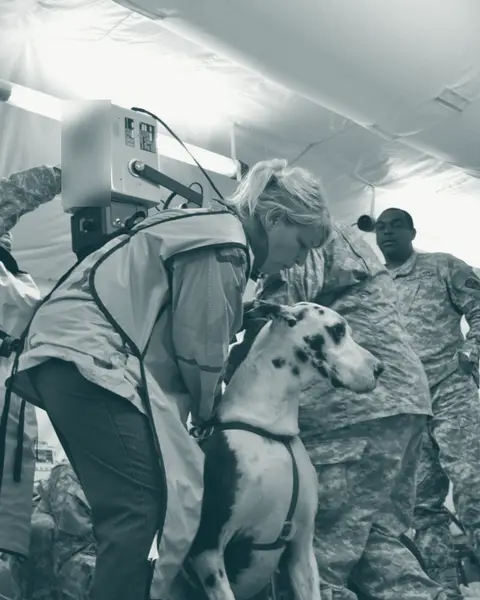
Note the lead apron and the hands keeping clear of the beam. Radiation safety equipment, aprons, thyroid shields and positioning aids, is inexpensive next to the generator but should be on the same quote, so the practice is not buying it piecemeal later.
What about anesthesia and surgery?
Anesthesia is the purchase most often bundled with a surgery or dental suite upgrade, and the one with the most small decisions inside it: vaporizer agent, circuits, ventilator, scavenging and monitoring. Our practice note on veterinary anesthesia machine financing walks through the gas path and what each component adds to the quote.
Opening or buying a veterinary practice
As with dental and medical offices, buying a practice is usually funded with a practice loan from a bank or an SBA-backed lender, because most of the price is goodwill. Real estate and construction usually go there too. The equipment for a new hospital, or the upgrades a new owner wants after closing, can be financed separately with the equipment as collateral, which keeps the main loan smaller. The SBA's own loan program pages explain the 7(a) and 504 options many buyers use.
Is used veterinary equipment a good idea?
For a lot of the hospital, yes. Surgical tables, kennels, wet tables and many monitors last a long time, and buying them used frees money for imaging or dentistry. Used imaging and anesthesia equipment is worth more care: check the service history, confirm parts are still available and make sure someone local will maintain it. We finance used equipment from dealers and from other practices, and the age of an asset can affect the term.
Veterinary financing questions
Can I finance equipment bought from another veterinary practice?
Yes. Private sales between practices can be financed. We will ask for the seller's details, the serial numbers and some evidence of condition and ownership.
Can you finance a whole new veterinary hospital?
We can finance the equipment, up to $5,000,000 per transaction. Construction, real estate and the purchase of an existing practice are usually funded with a bank or SBA-backed practice loan alongside it.
Do you finance equipment for practices owned by a corporate group?
We finance practices with a range of ownership structures. Tell us which entity owns the practice and which will sign the agreement, and we will tell you what we need.
How quickly can a veterinary equipment deal fund?
A clean hospital file is often decided on the day it reaches us, and the vendor is usually paid one to two business days after approval. Larger packages that call for financial statements run a little longer.